Picture
Within my ever growing collection of photographic objects are a few photos known as Cabinet Cards.  In the mid 1800's photographers began attaching thin albumen prints to a thicker cardboard and were modeled in size (2x3.5) and intent on the calling or buisness card. By the 1870's the size increased to about 4.5x6.5 inches but maintained the albumen print on adhered to the board.  The cards were greatly popular for both the photographer and consumer.  For the photographer they had an easy marketing  in the very form of its product.  Their popularity ran through the early 1900's when it became increasingly possible to photograph with ones own camera apart from the studio.

One of the things I love about these cards is that it answers a few questions about these mysterious photographs...who took the photograph, and where was it taken.  As you can see from the image up in the corner, the photographer was Albert Blankhorn in Koln or Cologne, Germany.   

Once you know someones name, you can begin to do a little cyber sluething.  Here are some more photos taken by Albert.  His studio (Atelier) was located at 79 High Street (Hohestrasse) which you can still find on Google maps here.  While you are there, take a look at the street view. Perhaps this is even the shop where he once worked.  With the help of Google translate, we can figure out what the lower left means. 

While some of the paper is missing, it says something like "Portraits through/by work in oil, pastel, watercolor, and platinum prints.

"vergrösserungen nach jedem bilde" - "Magnifications for every fancy"  

"die platten bleiben fur nachbestellungen aufbewahrt" - "The plates remain stored for repeat orders."  So apparently one could order reprints down the road.

In the upper right hand corner, we learn the Mr. Blankhorn was the court photographer (Hof-photograph) for what roughly translates as the Grand Duke of Hesse on the Rhein (Sr.Kgl.Hoh.d. Grossherzogs v.Hessen u.bei Rein).  Learn about the House and Rulers of Hesse here.  Given the dates of usage for Cabinet Cards, perhaps we may assume, that his reference to the Grand Duke refers to Louis IV.


Picture
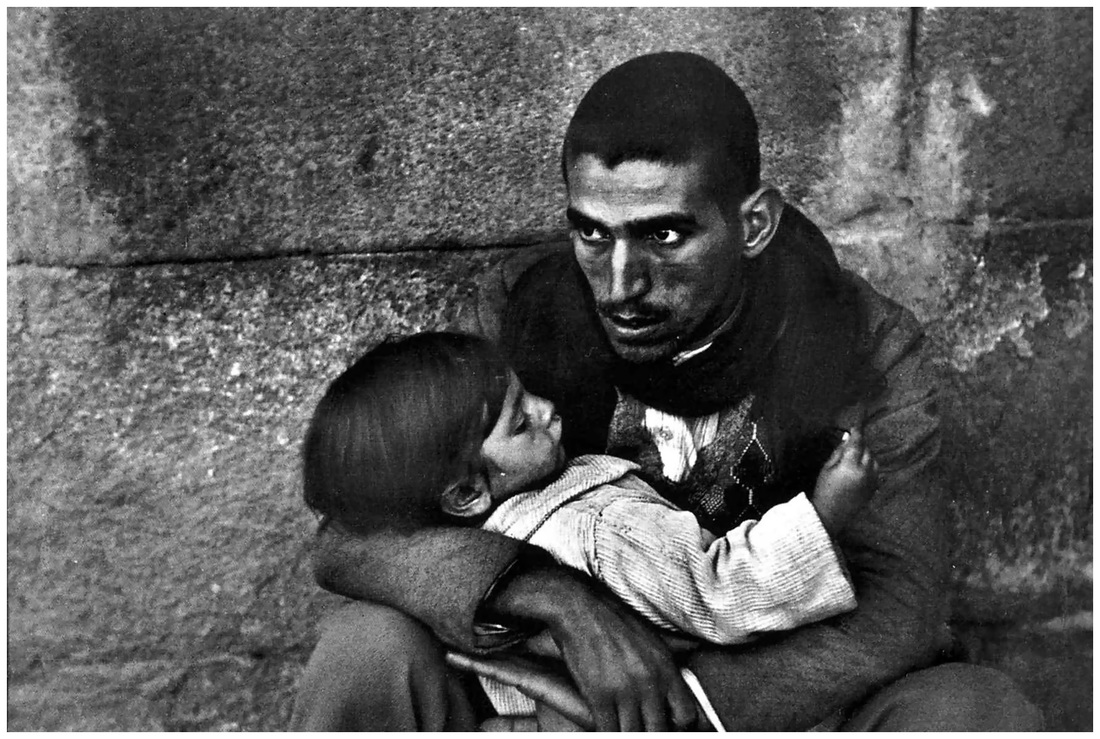
A couple of weeks ago I posted on  a photo I picked up over Easter of a mother holding a child still during a photo.  I metnioned how this forms a motif in vintage studio photography of the hidden mother.  

I bumped into a great site this morning that has a good number of example the "Invisible Mother" as they call it.  I suppose I understand the practice considering the sqirmy or frightened child, but why cover the head of the mother?  Why not photograph the two together or instead draw upon a Madonna and Child sort of precedent?  Some of the photos in this motif do hide the mother quite well, others...well...do not.  Because they are so obvious, they look rediculous...and kinda creepy.  Anyway...Enjoy.  


I wouldnt call it writers block...
I wouldnt call it procrastination...
I am not sure what this feeling is but it is one that I recognize often.  Two weeks from tomorrow I leave for the College Theology Society and National Association of Baptist Professors of Religion's joint annual meetings in San Antonio.  At which, I will be presenting a paper entitled "Jesus Gave Me This: Deciphering the Overlap of Spiritual Language in the Creative Process.  So, for the past week I have been plugging away at my paper.  I try to write for at least a few hours a day and have spent up to 6-7 hours reading and writing a day.  Today though, I feel as if I have hit a wall.  I am close to being done...but everything....and I mean everything is more interesting than this paper right now.  I recognize a similar problem when reading.  Often, I will thoughtfully engage a book for 200+ pages or whatever, but so often I cannot force myself to concentrate enough on the last chapter or conclusion.  I am so close why can I not finish either well. It seems there is something in an anxiety of getting done that keeps me from focussing on the end.  

I suspect that I need some time off.  Sadly, my only time out of the apartment yesterday was to bring the trash away and to go grocery shopping. My computer sits right next to a window and while it looks out over the apartments parking lot, it is a beautiful day again, the trees are leafing out, the lawn is growing.  Summer has come to Grand Forks.  

Please join me in my prayer today for focus, clarity and  
 
 
Picture
If you are a regular visitor here you know my long running interest with vernacular photography.  Over Christmas break in California, I bumped into this little piece at an antique shop.  Then a second one.
And now a third one.  

This one is about the size of the first (3 inches from point to point), is in better condition (the strings are not unravelling), and it has two points where the hanging string is attached.  LIke the others, the string is wrapped around cardboard and the strings are held in place by nails on the points of the star.  The photograph, which is about 1x1 inch, looks to be a standard paper image.  

This is your new blog post. Click here and start typing, or drag in elements from the top bar.
 
 
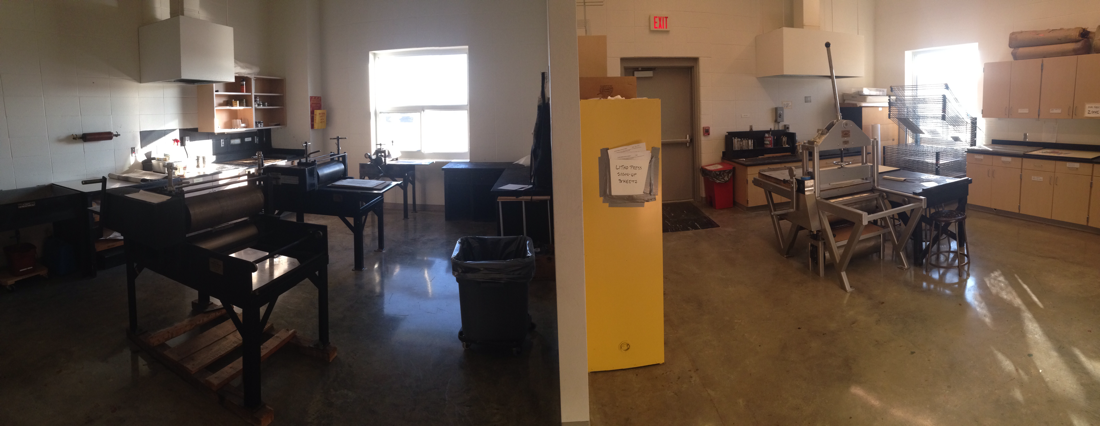
As a graduate student at UND, who also lives on campus, and took a significant amount of credits over the summer during the MFA program, this is one of the happiest days of the year.  Not only do things transition to a different pace of life and season of fun things to do, the undergraduates students, for the most part, are gone.  The studios open up and are generally quiet to get a lot done.  I've wondered over the past few years is it troubling that as a future educator that I am so relieved when students leave?  I know faculty are ready for their breaks too.  I suspect that I will be as well when I am teaching.  Now though, as a graduate student, I suspect it is pure selfishness.  Not in a mean spirited way, because many of the undergrads are great to have around.  But there is something to having those workspaces all to oneself.  And since I dont have money for a press and studio of my own, UND's will have to suffice until that time.  For all my friends out there teaching and struggling to finish grading...strength and peace be with you.
 
 
Occasionally I see some good postings off of Facebook....this happens to be one of them.  If you are a photographer, you would do well to check this out.
The Photography Tips that 96 Photographers Wish They Would've Learned Sooner.
Enjoy
 
 
Picture
One of my all-time favorite movies is Empire Records.  The film depicts the efforts of several high school teens fighting to keep their beloved record store and jobs while the owner sells out to the “man.”   Anyway, one of my favorite lines in this favorite movie comes from the character AJ when in trouble with the manager says, “Who knows where thoughts come from? They just appear.”

AJ’s comments describe a feeling often associated with the creative impulse and the difficulty in defining the creative process.  Sometimes ideas just appear…or seem like they do. 

Sometimes I am simply amazed at the human mind and its creative ability.  So perhaps it is ironic that I am working on a conference paper on the source of the creative idea when this realization comes around again.  Yesterday I was at an impasse on my paper.  I was stuck and could not figure out how to order and transition between various pieces of the paper.  By midday I had largely put the impasse out of mind with the intent of returning when I was mentally ready to tackle the issue.  I went to bed like normal.  But I awoke (was I asleep or someplace in between?) and knew how to make order the disparate pieces of the paper.  How does that happen?  This is not the first time this has happened either.  There are nights when I have wrestled in a fitful sleep with words and ideas all night…over and over I turn the problem.  I awake with little rest and no solutions.  And yet, in seminary when working day and night on my thesis, it happened several times when I was stuck on a transition point that the words and sentences came.  But where do these ideas and solutions come from?  What is it about sleep or the relaxation of the brain into dreaming, that allows for the creative mind to keep working?

I’m not sure…but I am thankful when it does. 


Picture
In my ongoing effort to migrate from my old blog AOA, I am continuing in a series of reposts.

One of my favorite books on photography is Geoffry Batchen's Each Wild Idea. The book contains 9 essays wrestling with the histories of photography. My favorite chapter, not surprisingly, is on vernacular photography. Batchen's work attempts to elucidate the "complex matter of photography's conceptual, historical, and physical identity." He continues, "Morphology is another of those issues that most histories of photography ignore. Indeed, the invisibility of the photograph, its transparency to its referent, has long been one of its most cherished features.

Most of us tend to look at photographs as if we are simply gazing through a two-dimensional window onto some outside world. This is almost a perceptual necessity; in order to see what the photograph is of, we must first repress our consciousness of what the photograph is. As a consequence, in even the most sophisticated discussions, the photograph itself--the actual thing being examined--is usually left out of the analysis. Vernacular photographies tend to go the other way, so frequently do they exploit the fact that the photograph is something that can also have volume, opacity, tactility, and a physical presence in the world. In many cases, the exploitation involves the the subject of the photograph's intervening within or across the photographic act. These subjects make us attend to their photography's morphologies, and thus to look right at rather than only through the photograph. In this sense, vernacular photo objects can be read not only as sensual and creative artifacts but also as thoughtful, even provocative meditations on the nature of photography itself" (Pages 59-60).

One of the trajectories of my MFA show was a means to highlight is the physical nature of the photograph. Batchen's text was released in 2001, and since then the digital revolution has only picked up speed further minimizing the physicality of photographic objects. The vernacular photographic objects that I have collected over the past few years intend to highlight the diversity from this relatively young medium. Varying in sizes and processes, the objects mounted in artifact trays, encapsulated in drawers, bins etc intend to suggest the physicality of the photo object. It has been interesting to me in this process the varying sizes, papers, and processes that were quickly cast away as the technology of photography advanced. Fewer and fewer sizes of film and prints were available over time to where we are now, if we print our images at all, have the options of 3.5x5, 4x6, 5x7 etc. Some of my favorite photos that I have collected are the smallest ones that are 2x3ish.


This past month has been a busy and exciting one with two solo shows up simultaneously.  Tomorrow, the show Concrete Abstractions at Minot State University will come down and I will make the 3+ hour drive out to pick up the work.  Minot State has 2 galleries, one in the art department and one in the library.  This exhibition was in the library.  It is a unique but quality space for displaying.  As Micah Bloom shown with his images below, the reflective surfaces mirror nice angles.  (A special thank you to Micah for his photographs...leave it to the photographer (me) to forget to shoot images of his own show at the opening).  I am immensely grateful to Minot State for the opportunity to show my work, much of which has not been seen beyond the walls of UND's art department.   
 
 
Once in a while I am reminded that I am a bit of an anomaly among my fellow artists in that I love writing and presenting papers at conferences.  I certainly don't have the empty space in my calendar to take papers on, but I do anyway.  They are another form of creative challenge to me.  

I've just completed a proposal for a conference at Dordt College in Sioux Center, Iowa called, The Christian Evasion of Popular Culture.    The deadline is May 1st so if you are interested, you better get going.

Also, this morning I received an email from the Transposition blog about a conference at Trinity Western University in Langely BC on Art and Ethics. The deadline for this one is June 15th so you've got a little more time with that one.